
What are the shipping methods you offer?
What are the shipping methods you offer? – Updated for 2025
We understand that choosing the right mode of transport is critical for your supply chain efficiency and cost management. Our independent has been updated to give you more control, transparency, and flexibility than ever before. Below is the complete breakdown of our shipping solutions, selection process, and post-purchase support.
1. Available Shipping Methods – At a Glance
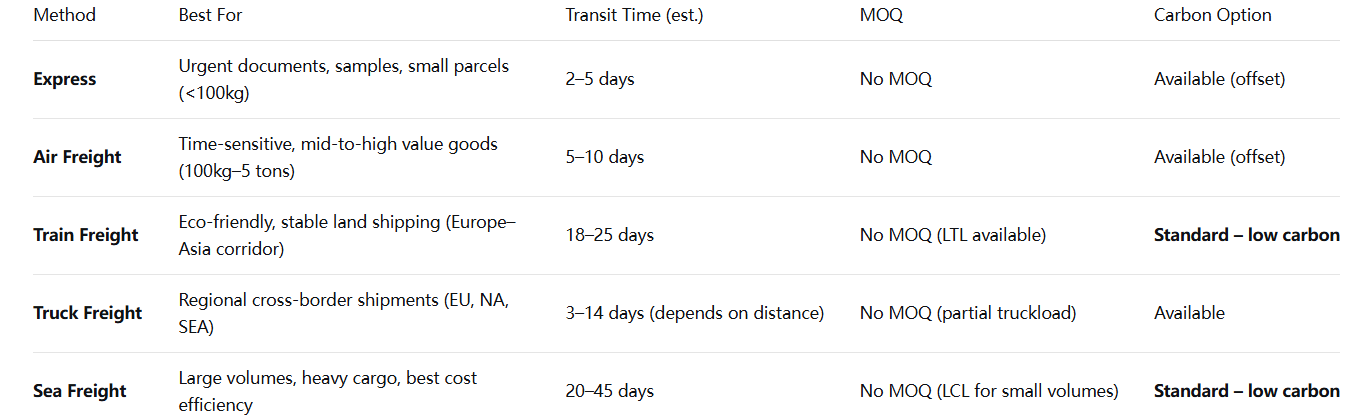
Note on MOQ: We have no minimum order quantity (MOQ) for any transport mode. Whether you need to ship a single carton via express or a 40ft container via sea, we provide a tailored quote.
2. How We Help You Choose the Right Mode of Transport
Our updated process is designed to save you time and money. Instead of guessing, you’ll receive a clear comparison.
Step 1 – Tell us your shipment details
Product type, weight, dimensions, and total volume (CBM)
Origin and destination postal codes
Desired delivery date (or “as soon as possible”)
Special requirements: temperature control, dangerous goods, fragile items, customs documents
Step 2 – Receive a personalized multi-carrier quote
Our sales team (or the new Shipping Calculator on your dashboard) will present:
Up to 5 mode-of-transport options ranked by speed and cost
All-inclusive pricing: freight + fuel surcharges + customs clearance (optional) + insurance
Estimated transit time door-to-door
Carbon footprint estimate for each option (g/kg CO₂e)
Step 3 – Expert recommendation
Based on your answers, we flag the optimal balance:
“Air freight is 3x faster but 70% more expensive than sea – if your inventory allows, sea is recommended.”
*“For 200kg of electronics to Berlin, train + truck combo saves 40% vs. air and arrives only 8 days later.”*
Step 4 – You decide
No hidden fees, no obligation. We hold the quote for 7 days.
3. Key Updates on Our website (2025)
Self-service shipping calculator– Log in to your account, enter dimensions, and instantly compare all 5 modes of transport with live rates.
Bulk order consolidation –If you have multiple orders going to the same region, we can combine them into one sea/train shipment to lower your per-unit cost.
Carbon-neutral shipping add-on –For express, air, and truck, you can pay a small offset fee (calculated at checkout). Train and sea already have low-carbon baselines.
Real-time tracking API –Track your shipment across different carriers from a single page, with proactive SMS alerts for delays or customs holds.
Dedicated logistics dashboard –View all past and active shipments, download invoices, and rebook the same mode of transport with one click.
4. Detailed Breakdown of Each Mode of Transport
✈️ Express (DHL, FedEx, UPS, etc.)
Ideal for: Urgent samples, spare parts, e-commerce orders under 100kg.
Pickup & delivery: Door-to-door, including customs clearance (DDP available).
Tracking: Real-time, often hour-by-hour.
Cost factor: High per kg, but no hidden fees.
MOQ: None – even 0.5kg accepted.
✈️ Air Freight
Ideal for: Time-sensitive production lines, seasonal goods, high-value items (e.g., electronics, fashion).
Airport to airport(we can arrange pickup/delivery on both ends).
Cost: ~3–5x more than sea, but 5–10x faster.
MOQ: None – we consolidate small air shipments with other clients to fill minimum airline requirements (so you pay only for your space).
🚂 Train Freight
Ideal for: China–Europe, Russia–Europe, or transcontinental routes. Best for medium to large volumes that are not extremely urgent.
Advantages: 40% cheaper than air, 30% faster than sea, and far lower CO₂ than air or truck.
Limitations: Only available on major land bridge corridors; not suitable for perishables without refrigerated containers (available but limited).
MOQ: No MOQ – less-than-container load (LCL) available.
🚛
Truck Freight
Ideal for: Cross-border trade within North America (USMCA), European Union, or Southeast Asia (e.g., Thailand–Vietnam).
Flexibility: Door-to-door, faster than train for short distances, can handle hazardous materials (with proper declaration).
Cost: Moderate – between train and air.
MOQ: None – partial truckload (PTL) pricing available.
🚢 Sea Freight
Ideal for: Large volumes (furniture, machinery, bulk raw materials), non-urgent orders, maximum cost savings.
Two main types:LCL (Less than Container Load): For shipments under 15 CBM – you share a container with other shippers.
FCL (Full Container Load): 20ft or 40ft container exclusively for you – lower per-unit cost if volume >15 CBM.
Port-to-port (we can arrange inland transport on both ends).
MOQ: None – LCL accepts as little as 1 CBM.
5. Post-Selection Support – What Happens After You Choose?
Once you confirm a mode of transport, our system automatically assigns:
A dedicated logistics coordinator (available via chat, email, or phone during business hours).
Documentation assistance – We prepare commercial invoice, packing list, bill of lading/air waybill, and any certificates (CO, FORM E, etc.).
Customs clearance (optional) – We work with licensed brokers in origin and destination countries to avoid delays.
Real-time tracking – Sent to your email/SMS at key milestones: “Picked up” → “Departed origin” → “Arrived at destination port” → “Out for delivery”.
Delivery confirmation & proof of delivery – Uploaded to your dashboard within 24 hours.
6. Frequently Asked Follow-up Questions
Q: Do I need to pay duties and taxes upfront?
A: We offer DDP (Delivered Duty Paid) for most countries via express and air. For sea/train, we recommend DAP (Delivered at Place) and you pay import taxes locally, or we can arrange DDP for an extra fee.
Q: What if my shipment is damaged?
A: All quotes include basic carrier liability. We strongly recommend optional all-risk cargo insurance (0.3–0.5% of cargo value). File claims through our support team.
Q: Can I change the mode of transport after booking?
A: Yes, within 24 hours of booking (before pickup). After pickup, changes may incur rerouting fees – contact your coordinator immediately.
Q: Do you ship to remote areas (islands, military addresses)?
A: Yes, but surcharges apply. We’ll inform you before quoting.
Q: What is your MOQ for each transport mode?
A: No MOQ for any mode. However, for sea LCL, we recommend at least 1 CBM to make the cost reasonable. For less than 0.5 CBM, express or air is often cheaper.
7. How to Get Started
On our updated independent, you can:
Use the instant shipping calculator on each product page or the “Shipping” tab in your account.
Request a manual quote by clicking “Get Shipping Quote” – our team responds within 4 business hours.
For existing orders: Go to Order Details → “Choose Shipping Method” – you’ll see real-time options and prices before finalizing checkout.
8. Summary of Key Benefits
✅ No MOQ – From a single sample to a full container
✅ All major modes of transport – Express, Air, Train, Truck, Sea
✅ Transparent comparison – See speed, cost, and carbon side by side
✅ Expert guidance – We recommend the best mode of transport for your specific needs
✅ End-to-end support – Pickup, customs, tracking, delivery
✅ Eco-conscious options – Train and sea as low-carbon defaults; offsets for others
If you still have questions about which mode of transport fits your MOQ, budget, or timeline, simply start a chat or email our logistics team. We’re here to help you ship smarter, not harder.
Are you looking for a reliable manufacturer of down home textile products?
We can quickly provide customers with market analysis, technical support and customized services.subscription